
 Image 1 of 1
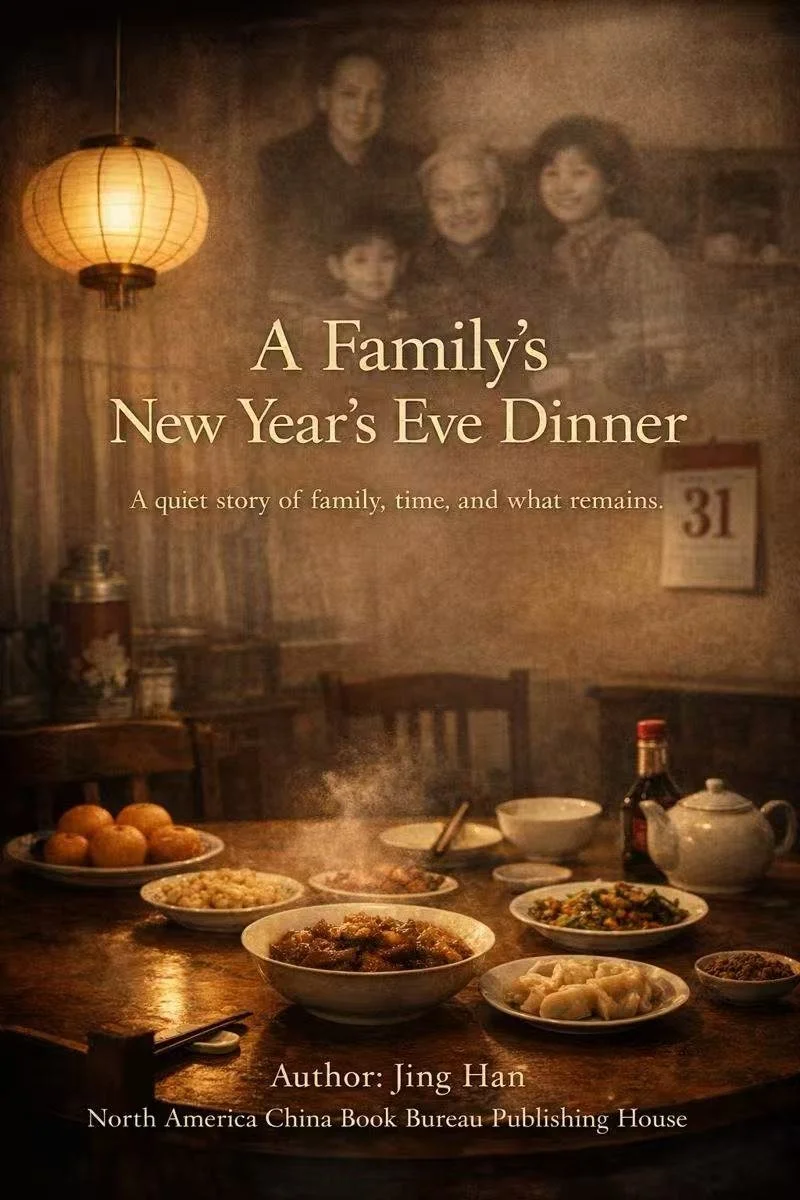
A Family’s New Year’s Eve Dinner
Author: Jing Han
Published by: North America China Book Bureau Publishing House
This is not a novel driven by dramatic plot,
but a quiet, deeply resonant work of memory literature that traces the life of an ordinary Chinese family across more than half a century.
A Family’s New Year’s Eve Dinner uses one recurring domestic scene—the New Year’s Eve family meal—as its emotional and structural center. From childhood to old age, from scarcity to migration, from togetherness to absence, the book records how time reshapes family, memory, and the way a person learns to sit at a table.
In the years of material shortage, a New Year’s Eve dinner meant careful planning, ration coupons, and patience stretched across an entire year.
During political turmoil, the dinner vanished altogether, replaced by silence, fear, and a single bowl of plain noodles.
Later, as history loosened its grip, illness, distance, and emigration quietly dismantled reunion once again.
In the end, the table remains—but it is never full.
Written in restrained, unembellished prose, this novel refuses melodrama.
There are no grand accusations, no sentimental reconciliation, and no forced warmth.
A father is branded, rehabilitated, and ultimately overtaken by time.
A mother sustains the household through calculation, endurance, and silence.
Siblings scatter across continents.
And the narrator moves through life—from child to son, from parent to solitary figure—learning that family does not disappear, but changes its form.
This is a novel about how history settles into ordinary gestures:
how food is prepared, how silence is shared, how presence gradually replaces explanation.
Rather than offering conclusions, the book moves toward stillness.
Rather than answering questions, it allows them to dissolve.
The final pages do not seek meaning.
The light is simply turned off.
The table remains.
Life continues.
A Family’s New Year’s Eve Dinner is for readers who understand that the most enduring stories are not the loudest ones—
but those that stay with us, quietly, long after the meal has ended.
A Family’s New Year’s Eve Dinner
Author: Jing Han
Published by: North America China Book Bureau Publishing House
This is not a novel driven by dramatic plot,
but a quiet, deeply resonant work of memory literature that traces the life of an ordinary Chinese family across more than half a century.
A Family’s New Year’s Eve Dinner uses one recurring domestic scene—the New Year’s Eve family meal—as its emotional and structural center. From childhood to old age, from scarcity to migration, from togetherness to absence, the book records how time reshapes family, memory, and the way a person learns to sit at a table.
In the years of material shortage, a New Year’s Eve dinner meant careful planning, ration coupons, and patience stretched across an entire year.
During political turmoil, the dinner vanished altogether, replaced by silence, fear, and a single bowl of plain noodles.
Later, as history loosened its grip, illness, distance, and emigration quietly dismantled reunion once again.
In the end, the table remains—but it is never full.
Written in restrained, unembellished prose, this novel refuses melodrama.
There are no grand accusations, no sentimental reconciliation, and no forced warmth.
A father is branded, rehabilitated, and ultimately overtaken by time.
A mother sustains the household through calculation, endurance, and silence.
Siblings scatter across continents.
And the narrator moves through life—from child to son, from parent to solitary figure—learning that family does not disappear, but changes its form.
This is a novel about how history settles into ordinary gestures:
how food is prepared, how silence is shared, how presence gradually replaces explanation.
Rather than offering conclusions, the book moves toward stillness.
Rather than answering questions, it allows them to dissolve.
The final pages do not seek meaning.
The light is simply turned off.
The table remains.
Life continues.
A Family’s New Year’s Eve Dinner is for readers who understand that the most enduring stories are not the loudest ones—
but those that stay with us, quietly, long after the meal has ended.