
 Image 1 of 1
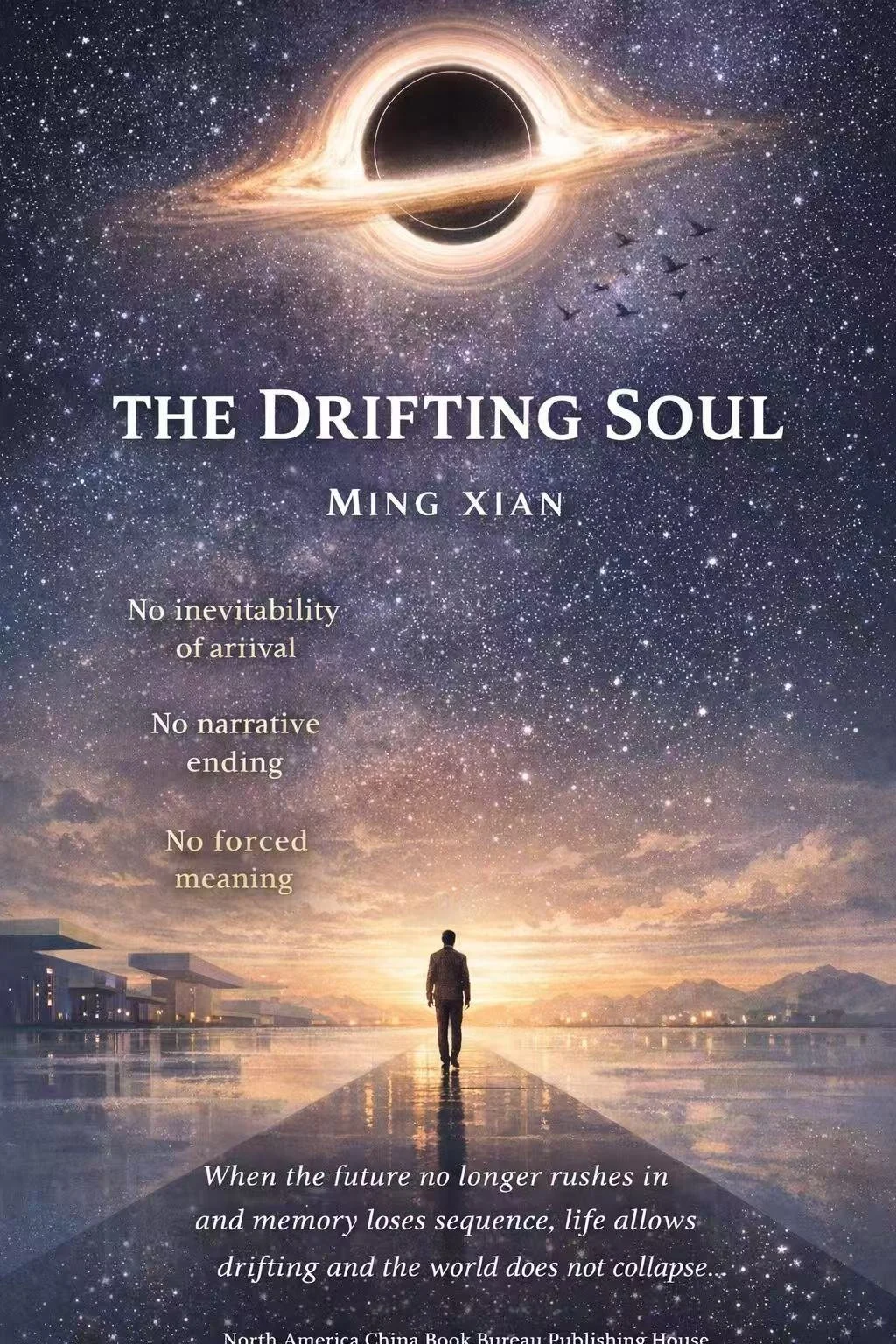
The Drifting Soul is a philosophical novel about consciousness, rebirth, memory, time, and the quiet gravity of black holes.
The story begins after an incomplete disappearance.
The protagonist returns from destruction and emptiness not fully erased, but profoundly unanchored. He is alive, yet no longer certain of who he is. Memory fractures, time loses its linear authority, and the future no longer arrives as an obligation.
Set in a world that is rational, benevolent, and nearly perfect in its systems of prediction and care, human life is gently optimized for safety, efficiency, and certainty. But within this success, a subtle anomaly emerges: people begin to stop rushing toward the future.
Some choose not to decide.
Children refuse to become something too early.
Adults learn to pause, drift, and remain undefined.
Identity loosens, memory detaches from sequence, and time redistributes itself.
The protagonist stands at the edge of these changes—not as a rebel or a savior, but as an observer. He discovers that true freedom does not arise from opposing the system, but from a quieter posture: allowing life to exist without explanation or completion.
The Drifting Soul is not a dystopian novel.
It is not about collapse, rebellion, or catastrophe.
It is about what happens after success, when certainty becomes too heavy and optimization begins to suffocate possibility.
This is a novel about presence rather than purpose, openness rather than resolution. It offers no final answers, only a gentle question:
What if meaning were optional?
In the end, The Drifting Soul does not conclude.
It remains—
just as existence does.
The Drifting Soul is a philosophical novel about consciousness, rebirth, memory, time, and the quiet gravity of black holes.
The story begins after an incomplete disappearance.
The protagonist returns from destruction and emptiness not fully erased, but profoundly unanchored. He is alive, yet no longer certain of who he is. Memory fractures, time loses its linear authority, and the future no longer arrives as an obligation.
Set in a world that is rational, benevolent, and nearly perfect in its systems of prediction and care, human life is gently optimized for safety, efficiency, and certainty. But within this success, a subtle anomaly emerges: people begin to stop rushing toward the future.
Some choose not to decide.
Children refuse to become something too early.
Adults learn to pause, drift, and remain undefined.
Identity loosens, memory detaches from sequence, and time redistributes itself.
The protagonist stands at the edge of these changes—not as a rebel or a savior, but as an observer. He discovers that true freedom does not arise from opposing the system, but from a quieter posture: allowing life to exist without explanation or completion.
The Drifting Soul is not a dystopian novel.
It is not about collapse, rebellion, or catastrophe.
It is about what happens after success, when certainty becomes too heavy and optimization begins to suffocate possibility.
This is a novel about presence rather than purpose, openness rather than resolution. It offers no final answers, only a gentle question:
What if meaning were optional?
In the end, The Drifting Soul does not conclude.
It remains—
just as existence does.