
 Image 1 of 1
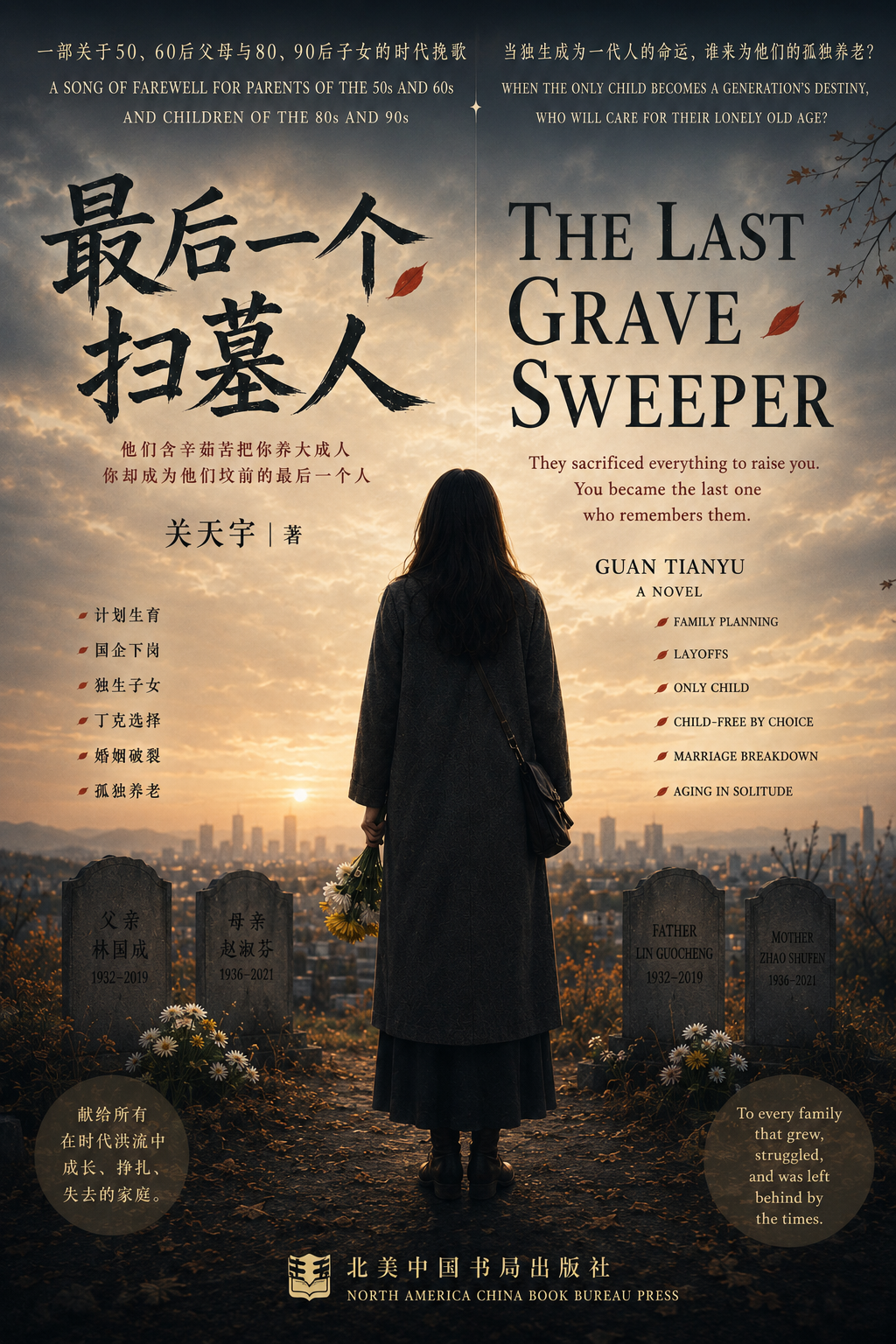
The Last Grave Sweeper
The Last Grave Sweeper
Author: Guan Tianyu
North America China Book Bureau Press
Book Description
Some people leave this world, yet someone still remembers them.
Others leave, and no one is left to light a stick of incense at their graves.
The Last Grave Sweeper is a moving realist novel set against more than four decades of China's social transformation. Through the rise and decline of an ordinary family, it portrays the hopes, sacrifices, disappointments, and loneliness experienced by several generations as history reshaped their lives.
During the 1970s and 1980s, the national policy advocating "One Child Is Best" and the promise that "the state will take care of the elderly" profoundly influenced millions of Chinese families. Countless parents born in the 1950s and 1960s placed every dream, every sacrifice, and every hope on their only child. They endured the hardships brought by the restructuring of state-owned enterprises, layoffs, and economic uncertainty, believing that their children would one day build better lives and provide comfort in their old age.
As China entered the era of reform and opening-up, a new generation born in the 1980s and 1990s embraced different values. They pursued personal freedom, independence, and self-fulfillment, redefining marriage, family, and parenthood. Remaining child-free, delaying marriage, or choosing divorce gradually became accepted life choices for many.
Lin Wan is one of those only children.
Raised with unconditional love and immeasurable sacrifice, she receives the education and opportunities her parents never had. Yet after marrying, she and her husband decide to remain child-free, choosing freedom, careers, and travel over parenthood. While they enjoy years of modern urban life, her aging parents quietly wait for the grandchildren who never come.
Time, however, waits for no one.
Her father falls seriously ill. Her mother gradually loses hope. One after another, they pass away, leaving behind an old family home, two lonely gravestones, and memories that no one else shares.
Soon afterward, Lin Wan's own marriage collapses.
Divorced and preparing to begin a new life in a distant foreign country, she returns to her hometown one last time. Standing alone before her parents' graves, she carefully cleans the headstones, places fresh flowers on the earth, and burns incense in silence.
At that moment, she realizes a heartbreaking truth.
When she leaves this country, there may never again be anyone to visit these graves. No one will remember that two ordinary people once devoted everything they had to raising their only daughter.
She has become the last person who still remembers.
The Last Grave Sweeper is not a story of heroes or extraordinary events. It is a deeply human portrait of countless ordinary families who lived through China's dramatic social changes—family planning, the restructuring of state-owned enterprises, the struggles of raising an only child, the challenges of elder care, shifting attitudes toward marriage, and the profound demographic changes that continue to reshape society.
More than a family saga, this novel is a letter to generations born in the 1950s, 1960s, 1980s, and 1990s—a tribute to parental love, responsibility, memory, and the enduring bond between parents and children.
When the last grave sweeper finally turns away, silence returns to the cemetery.
The question that remains is not only who will remember the dead—but whether the lives of ordinary people, shaped by the tides of history, will one day be forgotten as well.
The Last Grave Sweeper
Author: Guan Tianyu
North America China Book Bureau Press
Book Description
Some people leave this world, yet someone still remembers them.
Others leave, and no one is left to light a stick of incense at their graves.
The Last Grave Sweeper is a moving realist novel set against more than four decades of China's social transformation. Through the rise and decline of an ordinary family, it portrays the hopes, sacrifices, disappointments, and loneliness experienced by several generations as history reshaped their lives.
During the 1970s and 1980s, the national policy advocating "One Child Is Best" and the promise that "the state will take care of the elderly" profoundly influenced millions of Chinese families. Countless parents born in the 1950s and 1960s placed every dream, every sacrifice, and every hope on their only child. They endured the hardships brought by the restructuring of state-owned enterprises, layoffs, and economic uncertainty, believing that their children would one day build better lives and provide comfort in their old age.
As China entered the era of reform and opening-up, a new generation born in the 1980s and 1990s embraced different values. They pursued personal freedom, independence, and self-fulfillment, redefining marriage, family, and parenthood. Remaining child-free, delaying marriage, or choosing divorce gradually became accepted life choices for many.
Lin Wan is one of those only children.
Raised with unconditional love and immeasurable sacrifice, she receives the education and opportunities her parents never had. Yet after marrying, she and her husband decide to remain child-free, choosing freedom, careers, and travel over parenthood. While they enjoy years of modern urban life, her aging parents quietly wait for the grandchildren who never come.
Time, however, waits for no one.
Her father falls seriously ill. Her mother gradually loses hope. One after another, they pass away, leaving behind an old family home, two lonely gravestones, and memories that no one else shares.
Soon afterward, Lin Wan's own marriage collapses.
Divorced and preparing to begin a new life in a distant foreign country, she returns to her hometown one last time. Standing alone before her parents' graves, she carefully cleans the headstones, places fresh flowers on the earth, and burns incense in silence.
At that moment, she realizes a heartbreaking truth.
When she leaves this country, there may never again be anyone to visit these graves. No one will remember that two ordinary people once devoted everything they had to raising their only daughter.
She has become the last person who still remembers.
The Last Grave Sweeper is not a story of heroes or extraordinary events. It is a deeply human portrait of countless ordinary families who lived through China's dramatic social changes—family planning, the restructuring of state-owned enterprises, the struggles of raising an only child, the challenges of elder care, shifting attitudes toward marriage, and the profound demographic changes that continue to reshape society.
More than a family saga, this novel is a letter to generations born in the 1950s, 1960s, 1980s, and 1990s—a tribute to parental love, responsibility, memory, and the enduring bond between parents and children.
When the last grave sweeper finally turns away, silence returns to the cemetery.
The question that remains is not only who will remember the dead—but whether the lives of ordinary people, shaped by the tides of history, will one day be forgotten as well.